The Truth About Coaching for Freelance Audio Engineers
There are more online courses for audio engineers than ever. Most of them promise some version of the same outcome: a full calendar, predictable income, a marketing system that runs itself, maybe even ads that magically work on five dollars a day.
The argument about these programs usually gets stuck in the wrong place. People debate whether the claims are realistic, whether the instructors are qualified, or whether the tactics actually work. The conversation quickly devolves into vetting whats promised in the funnels and not actually what the courses or blueprints have to offer. People are right to be skeptical! Almost anyone with a few talking points and a way with words can create and even execute a marketing and business program to coach people in any number of ways on a number of subjects. For this Substack, I am going to focus on freelance audio engineering.
Full disclosure: I have been hired as a business consultant in this function and I even thought about making this a larger service offering at one point, but really its fairly difficult to properly run a consulting business and be an audio engineer, so I focus on the art now and just try to share as much opinion and information as I can. That said, in my opinion:
If you strip away the branding, the testimonials, the blueprints, and the jargon, most of these programs collapse into two functions:
First, they force a reframing of how the engineer relates to their work as a business.
Second, they impose external accountability for a short, intense window of time.
Everything else - funnels, ads, scripts, templates, “systems” - is implementation detail.
None of the information is secret. Pricing models, onboarding workflows, lead qualification, email sequences, SOPs, automation tools, CRMs: all of this is publicly available. Most of it has been written about endlessly. The scarcity is not knowledge. The scarcity is execution.
Once you look at it that way, the entire coaching ecosystem becomes easier to understand.
Most engineers are choosing between three options, whether they consciously frame it that way or not.
The first option is self-guided change. This is the cheapest option financially and the most expensive cognitively. You take responsibility for diagnosing your own problems, choosing a direction, building systems, and holding yourself accountable while operating under uncertainty. You have to decide what matters, what doesn’t, and when “good enough” is good enough. There’s no one to tell you if you’re doing it right, and no external pressure to keep you moving when motivation collapses.
Most people don’t stall here because they lack intelligence. They stall because sustained self-direction is exhausting. Freelance work already consumes attention and energy. Asking yourself to also be the strategist, manager, and disciplinarian is more demanding than most people admit.
The second option is paid accountability with structure. This is where the controversial price tags live. Three thousand dollars. Five thousand. Eight thousand. On the surface, it feels absurd. But what you’re actually buying isn’t insight. You’re buying time compression and enforcement.
Someone else tells you what to do today. Someone else checks whether you did it. Someone else forces decisions you’ve been deferring: pricing, scope, positioning, boundaries. From a business perspective, this is simply renting executive function for a defined period of time. Its something that many professionals and executives do all the time in their personal education. In the art world (punks I’m talking to you) it looks and feels different and might be more in the form of apprenticeships and mentors, but its relatively similar.
For some people, especially those stuck in indecision loops or emotional avoidance, paying for pressure is rational. Not aspirational. Rational.
Storytime: I went through this myself about 11 years ago when I did the first MTWM with Steve Albini. I was at a point in my career where I could have accumulated a ton of analog gear and workflow, or I could invest in the world of digital recording. I paid $4k to go to France for a week with 14 other engineers to learn from one of the best recording engineers of the last 40 years. Not only did I love the music he worked on and made himself - but I thought if there is anyone who is going to convince me one way is better than the other, its going to be him.
Well I went he laid it out very simply: Analog recording ensures that the document of recorded music will stand the test of time over proprietary digital formats. The problem is curating the analog equipment and studio configuration at scale is expensive, and more expensive than I could justify at the time. Now, I definitely love the idea of a fully kitted out analog studio, but I have established a workflow and level of professional recording that keeps me booked regularly. But that experience of working with Steve, and the handful of times I was able to work with him in the years since provided a very valuable education.
The third option is inaction disguised as skepticism. This is the most common path, and it’s the least honest. People reject courses on principle, not because they’ve built systems themselves, but because skepticism feels safer taking a look at yourself and considering what you need to change. They tell themselves they’re too smart to fall for hype while quietly doing nothing differently month after month. I’m not saying every course works. I am saying it’s usually easier to criticize a system from the outside than to risk discovering it isn’t right for you. Life is sometimes an expensive endeavor. Sometimes it drains your soul, sometimes it drains your bank account.
Over time, this becomes a worldview: the industry is broken, the algorithm is rigged, clients don’t value audio, and frustration grows toward people who seem to succeed effortlessly or hold visible positions without a history of consistent work or community involvement.
At that point, the question stops being “Is this course worth it?” and becomes “What am I trying to avoid doing myself?”
There’s no hidden playbook anymore. You’re not paying for secrets; you’re paying to understand how the business actually works. When others seem to succeed effortlessly, it’s usually because they’re talented, in the right places, and connected to people who see their value. That explanation gets dismissed because it sounds too simple. “Talent plus position plus relationships” doesn’t feel satisfying, so people go looking for hacks instead.
You are paying for someone to sit with you - metaphorically - and make sure you understand and do the boring, repetitive, uncomfortable work that turns a freelance practice into something repeatable. Daily follow-through. Tightening scope. Raising rates. Saying no. Working through imperfect systems. Having conversations you’ve been avoiding. Tolerating short-term instability in exchange for long-term clarity. Every engineer you have ever looked up to either figured this out on their own or had someone else deal with it for them. Some folks were employed by studios and some folks have managers who find and negotiate work for them. You want it to happen organically because that always feels like the path of least resistance - when it all “just works out” and you have a steady stream of work coming in the front door. It doesn’t always work that way and thats part of the reason the price for some of these courses feels offensive.
Paying for accountability feels like admitting a personal shortcoming. Creative professionals are trained to value insight and originality, not consistency and enforcement. Audio engineers, in particular, have usually looked down upon blatant outright self-promotion, but that was easier to justify when the market for engineers with taste and professional setups wasn’t as oversaturated.
So when someone on the internet says it’s a scam, or that you shouldn’t have to pay for it, or points out flaws in the system - it’s not that they’re wrong; it’s that their objection is really to the presentation of enforced self-accountability. Not everyone has the intuition, temperament, or internal structure to self-regulate and simply make things work. In fact, I’m comfortable saying that most people carry an abstract sense of the “right” way to do things and then improvise their execution almost entirely at first.
The more interesting question is ethical, not financial, and it’s one most programs avoid: do these systems actually teach people how to internalize accountability? It’s easy to set goals. I can do it right now as I write this: in 2026 I want to 1) do more label work, 2) build a dedicated mixing room in my home, and 3) find more opportunities to produce and curate work with artists I love. But the discipline required to make those things real—reaching out to label contacts consistently, designing and executing a room build from the ground up, and investing time and energy into developing artists—has very little to do with ambition and everything to do with follow-through, repetition, and tolerance for the admin work that no one cares about on social media.
A six-week sprint can produce momentum. That’s not hard. Focused systems and durability is harder. If everything collapses the moment the check-ins stop, the business was never made scalable. It was temporarily supervised.
That’s the real fault line. Not whether courses are “scams,” but whether they build capacity or dependency.
Their primary success metric is short-term compliance: did you post, did you send the emails, did you run the ads, did you raise your rates, did you book calls. The structure is optimized for visible motion inside a fixed window of time, not for rewiring how someone regulates their own behavior once the course structure is removed.
Internalized accountability requires things these programs usually don’t prioritize:
-
taking time to understand why you keep avoiding certain work
-
teaching people how to make their own decisions instead of just following a script
-
helping people figure out what’s wrong when something stops working
-
slowly taking away outside pressure instead of cutting it off all at once
-
accepting that boredom and backsliding are normal when you’re trying to build something that lasts
That’s hard to sell. It doesn’t fit a six-week promise. It doesn’t screenshot well.
What does happen sometimes is that people learn things indirectly. A small group figures out how the system works while they’re inside it. They start to see what the check-ins are actually for. They learn what questions are coming. Over time, they set their own pace and routines. Those people leave with something that lasts—not because the program taught it to them, but because they figured it out themselves.
That difference matters.
If someone already understands themselves fairly well and just needs a push to get moving, a short period of structure can help them build lasting habits. But if someone has trouble managing themselves in the first place, these systems often make them dependent. When the meetings and calls end, the behavior usually stops too.
The truth is these systems are good at getting people started but they are hit-or-miss when it comes to teaching people how to work independently.
A program that really teaches self-accountability would work very differently from most online courses.
First, scripts would be used as practice tools, not permanent instructions. Early on, people might be given example emails or pricing language, but they would be asked to change them and explain their choices. The goal wouldn’t be to copy the script exactly, but to learn how to make decisions. Over time, the scripts would go away, and people would be guided to think through problems on their own.
Second, reflection would be part of the work, not a side exercise. Instead of only checking whether tasks were completed, the program would ask questions like: What did you avoid this week? What felt uncomfortable? Progress would mean being able to spot problems early without someone pointing them out.
Third, boredom would be treated as normal. The program would explain that once the excitement fades, the work becomes repetitive—and that this is expected. Instead of constantly introducing new tactics to stay motivated, people would learn how to keep showing up even when the work feels dull.
Fourth, support would slowly decrease over time. At the beginning, there might be frequent check-ins and clear structure. As the program continues, those check-ins would happen less often. People would be expected to notice missed actions themselves and decide how to fix them. This gives the habits time to stand on their own.
In short, a real self-accountability program would be designed to make itself unnecessary. The goal wouldn’t be to keep people dependent on the system, but to help them trust their own judgment and keep going on their own.
In future pieces, I plan to break down some of the more popular courses and what they actually teach in practice. I’m curious how you’re experiencing coaching culture in the current state of the industry.
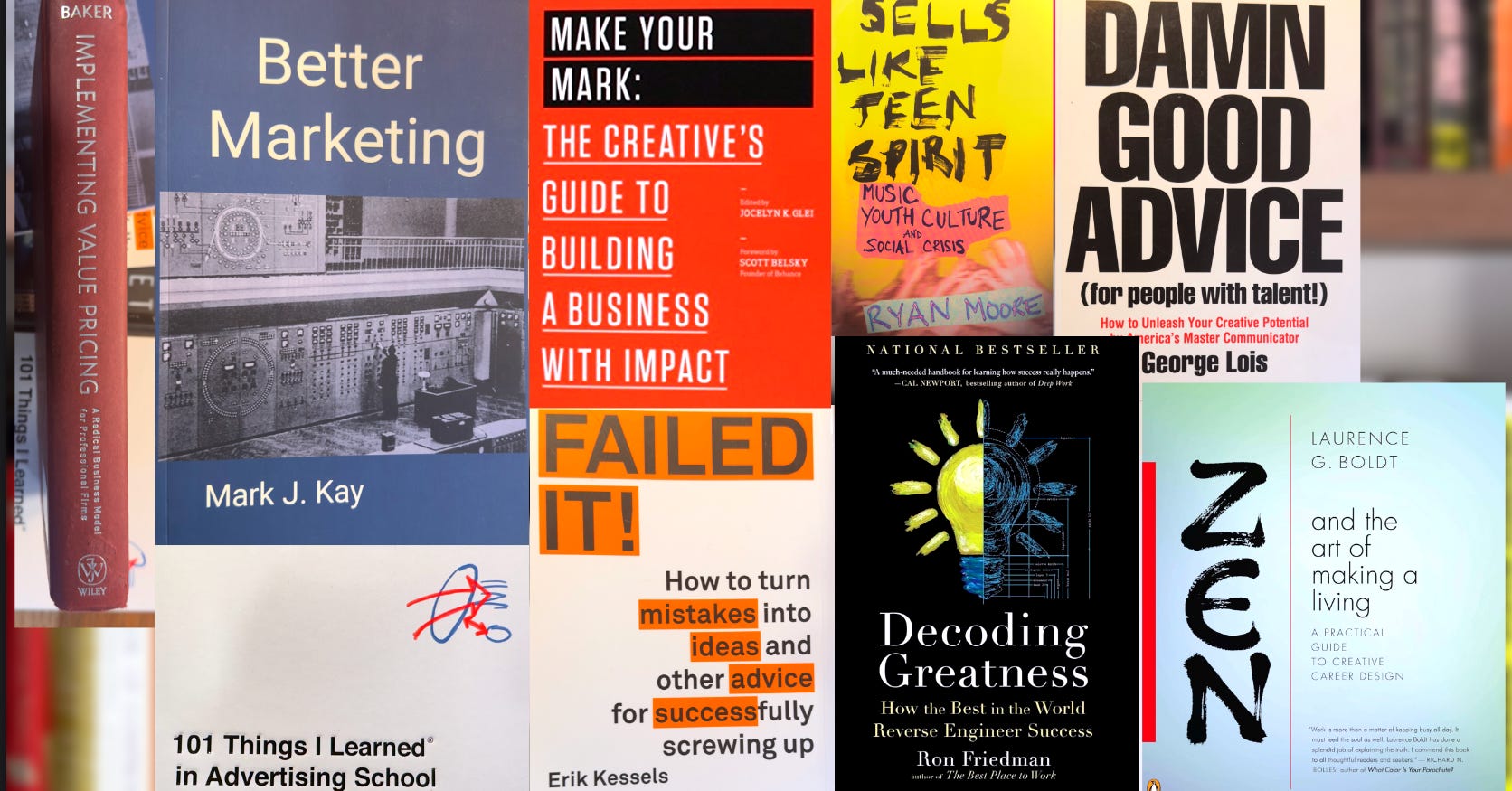
As a bonus here, I am going to share a list of books that have been INSTRUMENTAL in how I understand and run my own business. I hope you will check them out, all links are affiliate links so there is a possibility I will get a commission on the sale if you buy it.
-
Implementing Value Pricing: A Radical Business Model for Professional Firms — Ronald J. Baker
This is a book about unlearning the idea that your time is the product. It reframes freelance work around outcomes, trust, and perceived value, and forces you to confront how underpricing is usually a systems problem, not a confidence problem. Essential reading if you sell expertise rather than widgets. -
Better Marketing: What’s Really Working (and Why) — Mark Kay
A corrective to hype-driven marketing advice. This book is about fundamentals: positioning, message discipline, and doing fewer things consistently instead of chasing every new channel. It’s especially useful for freelancers who need marketing to support the work, not become a second full-time job. -
Make Your Mark: The Creative’s Guide to Building a Business with Impact — Jocelyn K. Glei
This book sits at the intersection of creative identity and economic reality. It addresses the uncomfortable transition from “I make things” to “I run a business,” without flattening the creative impulse. Useful for freelancers trying to scale without turning into content farms or burnout cases. -
Sells Like Teen Spirit: Music, Youth Culture, and Social Crisis — Ryan Moore
Not a business book, but an important lens. It examines how authenticity, rebellion, and subculture are absorbed, monetized, and neutralized. For freelancers, it’s a reminder that “anti-establishment” branding is still branding, and that markets will happily sell your identity back to you if you let them. -
Damn Good Advice (For People with Talent!) — George Lois
This is about backbone. Lois argues that creative work without conviction is just decoration, and that safe ideas rarely build careers. For freelancers, it’s a reminder that differentiation comes from taste, judgment, and saying no—not from pleasing everyone. -
Zen and the Art of Making a Living — Laurence G. Boldt
A slow, grounding book that pushes against hustle mythology. It reframes success as coherence between values, work, and daily life. Particularly useful if your freelance business is technically “working” but feels misaligned or unsustainable. -
101 Things I Learned in Advertising School — Sally Hogshead & Ralph H. Kilmann
A compact set of principles about attention, persuasion, and human behavior. It’s less about ads and more about how ideas move. For freelancers, it sharpens your ability to explain what you do, why it matters, and why someone should choose you. -
Failed It!: How to Turn Mistakes into Ideas and Other Advice for Successfully Screwing Up — Erik Kessels
A counterweight to optimization culture. This book treats mistakes, misfires, and awkward outcomes as necessary inputs to original work. For independent operators, it reinforces that experimentation beats polish, especially when you don’t have institutional safety nets. -
Decoding Greatness: How the Best in the World Reverse Engineer Success — Ron Friedman
A demystification of “genius.” The book shows how top performers study, borrow, and recombine existing models intelligently. For freelancers, it legitimizes learning from peers and adjacent industries instead of pretending everything must be invented from scratch. My absolute favorite book on this list and I’ve referenced it thousands of times.
If you dont want to subscribe but would like to show your appreciation, buy me a coffee!