Architecture for Sound: On Kevin Shields, SUNN O)))), and the Demands of Maximalism
There’s a photo circulating of Kevin Shields’ live guitar rig — a sprawl of amps, cabs, routing, pedals, power, and sheer physical scale. Predictably, the reactions are the same as always: a chorus of people wondering why anyone would tour with such a setup when a Line6 Helix could “do the same thing.” The implication is that this amount of hardware represents stubbornness, ego, or a kind of luddite nostalgia.
That framing not only misunderstands Shields intention, it misunderstands a whole tradition of music-making where the apparatus itself is part of the art.
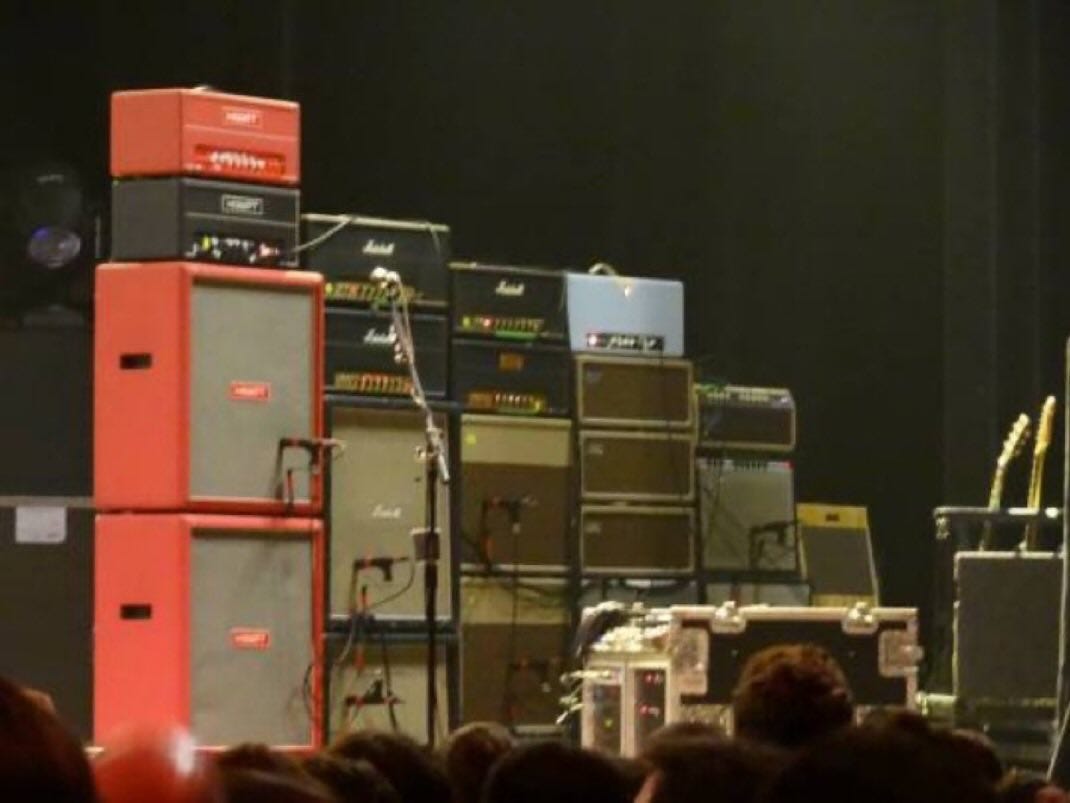
Shields’ work in My Bloody Valentine has always been tied to material complexity. The unique, collapsing shimmer of Loveless or the tidal surge of their live performances isn’t the product of a single signal chain. It emerges from interactions: phase relationships between amplifiers, feedback loops forming in the air, tremelo arm instability smearing pitch while room acoustics smear time. Everything in his rig — the inconsistencies, the near-chaotic overlaps, the excess — is purposeful. It draws you in and it might even spit on you.
Shields constructs an environment he plays inside. The amps and speakers don’t simply project sound; they generate a set of conditions that allow certain tones and textures to exist. The result is a distributed instrument: a system in which the interaction of many sources produces something no single source can.
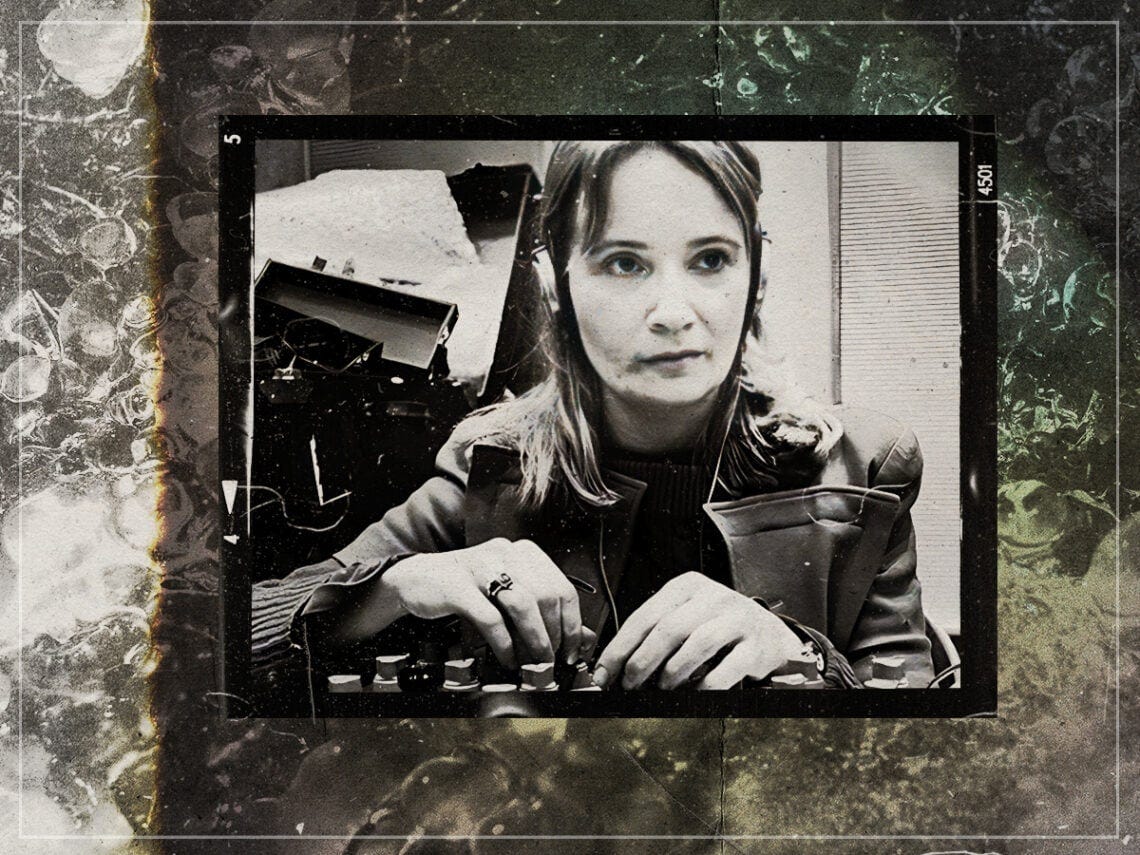
This approach has lineage. It reaches back to the slow-shifting phase patterns of Steve Reich’s early tape pieces, where two identical loops falling out of sync produced harmonies no one wrote. It reaches back to La Monte Young’s drones, which treated sustained tones as architecture rather than melody. It reaches to Maryanne Amacher’s work with auditory distortion products, where sound activated the listener’s body directly, and to Glenn Branca’s guitar orchestras, where cascades of overtone-rich sound became a vibrating structure you stood inside.
Shoegaze didn’t appear from nowhere. It came from experimental, process-driven work meeting the physical scale of amplified music. The “wall of sound” clichés obscure the actual idea: not walls, but fields of sound. Shields’ rig and the MBV stage plot is built to generate that field. The layering of amps creates micro-collisions and interference patterns. The stage volume shapes how the guitar feedsback, and how the player’s movements change that feedback in real time. None of this can be collapsed into a single DSP box, because the point isn’t the reproduction of a tone — it’s the reproduction of conditions.
On the other end of the maximalist spectrum sits SUNN O)))), often mentioned alongside MBV because of the visual similarity: towering stacks of amplification, fog, and bodies positioned inside the sound. But SUNN O))))’s maximalism operates on a different axis. Shields uses scale to generate motion. SUNN O)))) use scale to generate mass.
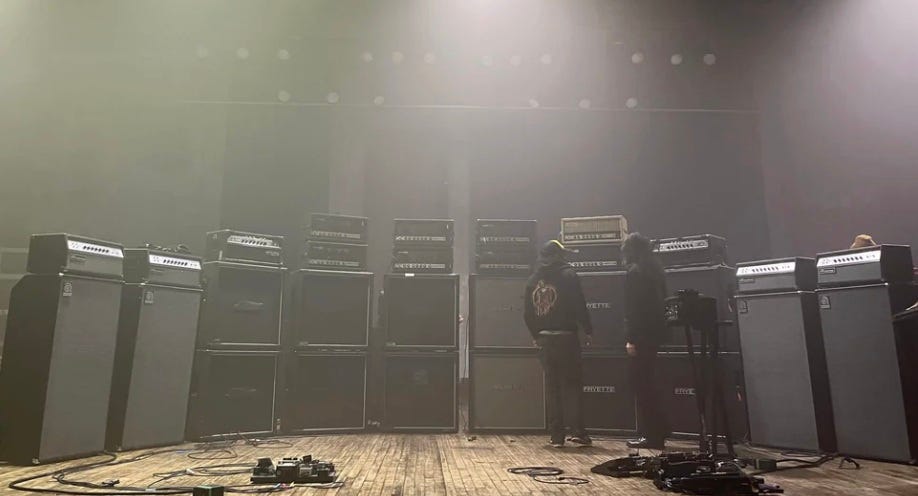
Their sound is monolithic by design. Rather than many contrasting voices colliding, they use many amplifiers reinforcing a single tone until it becomes dense enough to behave like matter. The aim is to create a sustained, room-filling drone that doesn’t move. Where the MBV sound bends, flutters, and collapses, SUNN O))))’s sound presses. They aren’t building a harmonic weather system; they are building architecture.
Both approaches require large systems, but for opposite reasons. Shields seeks instability and overlapping behaviors; SUNN O)))) seek immovability and pressure. The rigs look similar only because both philosophies demand a scale that resists miniaturization.
This is where online discourse often turns shallow. There’s an assumption baked into contemporary music culture that efficiency is inherently virtuous — that whatever can be made smaller, faster, lighter, or more portable should be. These are values imported from tech culture, not art. A digital multi-effects unit is a remarkable tool, and many musicians rely on it with great results. But to suggest it can replace the physicality behind MBV or SUNN O)))) is to mistake convenience for equivalence.
These rigs exploit the transformers in the amps, the speaker cones modulating each other, the feedback, the resonance of the room, and the sensation of standing in a movie pressure field.
When people joke that “MBV must hate their road crew,” what they miss is that the scale of this system is the entire point. Touring with something like this requires resources, coordination, and expertise. It demands a crew who understands that the system isn’t incidental to the music; it is the music.
What gets lost in the rush to flatten everything into efficient workflows is that some artistic ideas cannot be miniaturized without losing the very thing that makes them what they are. The architecture of the stage, the size of the amplification system, the physical realities of air movement. These are not optional for certain kinds of work and certainly limit some folks who see these setups as a part of their artistic identity.
Groups like My Bloody Valentine and SUNN O)))) occupy a rare space in contemporary music: they remind us that sound can still exceed the frame of the stage, overwhelm the body, and demand infrastructure rather than convenience. They belong to a lineage that treats amplification not as a tool but as a medium. In that sense, their rigs are no different from a pipe organ, an orchestra, or a monumental sculpture. They are built to produce phenomena that can’t exist at a smaller scale.
The modern world is filled with tools designed to make art easier to produce, transport, and store. That’s fine. But convenience is not the axis on which all art turns. Some ideas — some very specific and powerful ideas — rely on physicality, mess, and scale. They require systems big enough to misbehave. They require architecture for sound.
And the artists who pursue those ideas aren’t resisting progress.
They’re protecting a dimension of music that only survives when the room itself becomes part of the instrument.
Thank you for reading! You can support me by becoming a paid subscriber
