Analog Gear is Overrated. So are Plug-ins.

So glad I saw this today because it’s something I’ve been thinking about a lot lately, especially in relation to plugins as well.
I have no problem saying both of these things.
So much plugin marketing seems to boil down to one of two messages: “still using old plugins?” or “this costs more because it sounds like real hardware.”
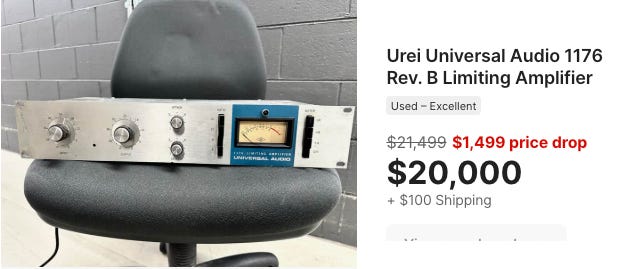
On the analog side, modern hardware clones often do a great job of replicating the functionality of the original gear, but in my opinion they rarely recreate the exact sound of the originals.
To me, context is the important part.
It’s not just the circuit. It’s the components, tolerances, transformers, aging, power supply behavior, and the way those pieces interacted with the rooms, consoles, workflows, and monitoring environments of their time.
A lot of the modern analog and digital tools we use today are, in many ways, better engineered than the originals, assuming they’ve been designed thoughtfully and not just built around marketing language.
The complication is that many of the components that gave vintage gear its reputation are either no longer manufactured, prohibitively rare, or can’t be used because modern electrical standards, safety regulations, and the entire material and manufacturing ecosystem have changed.
Lead is one example. Older solder joints aged in a very specific way over decades.
Beyond that, many of the original components simply no longer exist in their original form: op-amps, transistors, FETs and JFETs, certain VCAs, transformers, resistor types, ceramic and film capacitors. Sometimes the tolerances don’t match. Sometimes the materials don’t match. Steel alloys, core materials, winding methods, and insulation can all differ from the original gear.
A vintage unit’s noise floor, sag behavior, or transient response may partly come from a less regulated power supply.
Which, interestingly, becomes an argument for plugins in some cases.
A software model can emulate discontinued semiconductors, transformer hysteresis, capacitor nonlinearity, and even aging artifacts that modern hardware clones may not physically reproduce.
Sometimes the plugin may actually be closer to that sonic target than a hardware reissue.
But even that still misses the bigger point.
A device is not just its transfer curve, distortion profile, or time constants in isolation. It exists inside a signal chain, inside a room, through a monitoring system, with a human engineer making decisions.
A compressor or EQ does not “sound legendary” on its own.
Even if we perfectly reproduced a vintage unit, we are not listening through the same rooms, same monitors, same tape formulations, same converters, same mastering chains, same distribution mediums, or even the same listener expectations.
And honestly, there’s nothing wrong with that.
Because the way a piece of gear or a plugin makes us feel as engineers or artists is sometimes just as important than how it sounds in a strict technical sense.
Sometimes we want tactile knobs and faders because they change our mindset, our workflow, and our sense of inspiration.
To me, that’s where the real authenticity is.
Does it matter to you?
Does it matter to the artist?
In the current ecosystem, whether you want to work in a project room, home studio, professional studio, or commercial recording facility, all of those experiences are available.
If it matters, you find a way or you make compromises.
But making a compromise does not automatically mean one outcome will be better or worse simply because it’s analog or digital.
That part is still determined by judgment, taste, and decisions.